Abstract gold freight network over a dark navy background.
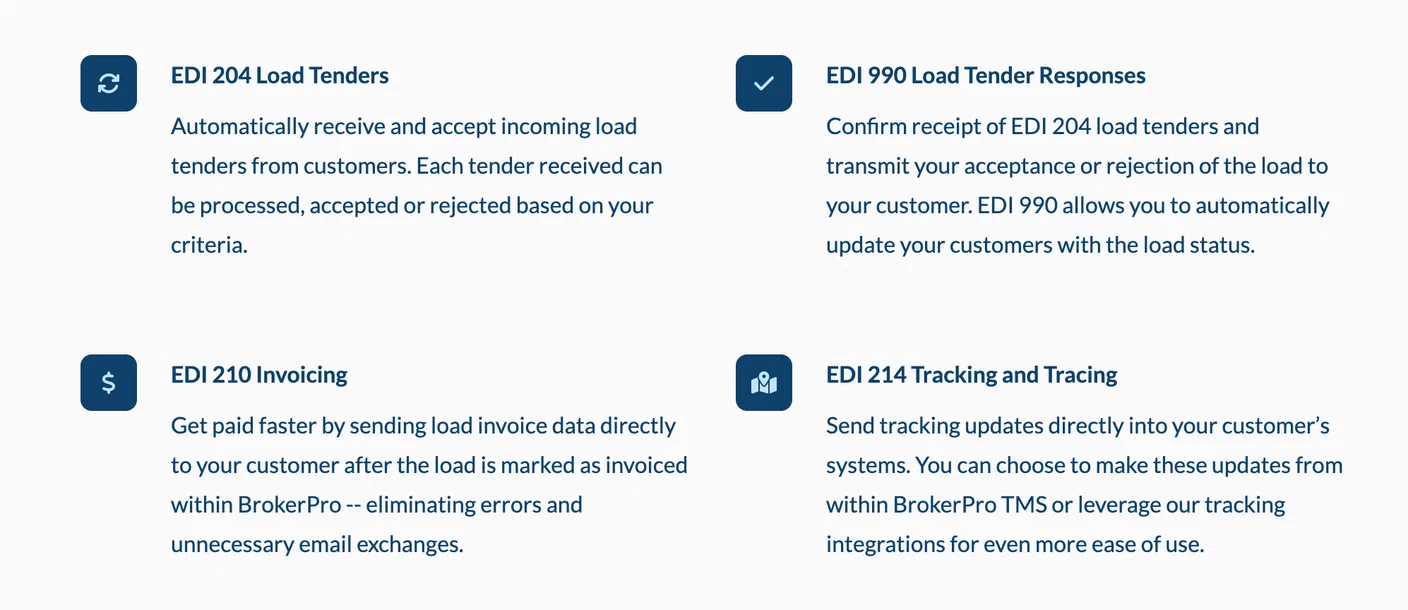
EDI 204 Load Tenders
Automatically receive and accept incoming load tenders from customers. Each tender received can be processed, accepted or rejected based on your criteria.
EDI 990 Load Tender Responses
Confirm receipt of EDI 204 load tenders and transmit your acceptance or rejection of the load to your customer. EDI 990 allows you to automatically update your customers with the load status.
EDI 210 Invoicing
Get paid faster by sending load invoice data directly to your customer after the load is marked as invoiced within BrokerPro -- eliminating errors and unnecessary email exchanges.
EDI 214 Tracking and Tracing
Send tracking updates directly into your customer’s systems. You can choose to make these updates from within BrokerPro TMS or leverage our tracking integrations for even more ease of use.

Organize core brokerage strengths in a simple grid that is easy to scan.

Use 2x2 Capability Grid to Explain Brokerage Value Clearly

This BrokerOS Web pattern helps freight brokerages organize important services, strengths, or process details in a way that is easier to scan. It gives visitors enough context to understand the message without forcing them through dense copy.

It works well when a page needs to explain multiple ideas, show how a service works, or make a capability easier to compare. The structure supports clarity and conversion while keeping the page connected to the broader BrokerOS Web system.
Clear structure
Break important services or strengths into focused sections that are easier for visitors to understand.

Scannable messaging
Make it easier for shippers and prospects to compare capabilities without reading dense blocks of text.
Trust support
Use concise copy and relevant context to create a more credible impression.
Service clarity
Explain what your brokerage does in a way that connects to real customer needs.
Flexible placement
Use this pattern on service overviews, homepage sections, about pages, or supporting pages where multiple ideas need structure.
Conversion support
Guide visitors toward the next step after they understand the message.

When to use this section

Use this pattern when your brokerage site needs to:
Screenshot of the 2x2 Capability Grid pattern.
When you need to explain a brokerage service or capability more clearly
When your homepage or service page needs more structure and visual support
When you want to break up long-form copy with more scannable sections
When visitors need to compare multiple brokerage strengths quickly
When service clarity should support the next conversion step

Ready to explain your brokerage more clearly?

We'll help you choose the right BrokerOS Web patterns for your brokerage site.

Best practices for using this pattern

Use this pattern when a brokerage message needs clearer structure, stronger context, and an easier path to action.
What kind of copy belongs in this pattern?
Use concise copy that explains a service, strength, or workflow in plain language. If a point needs more than a short paragraph, link to a deeper page instead of crowding the section.
Where should this pattern appear on a brokerage site?
Use it after the hero, inside a service overview, or on a supporting page where visitors need a clearer explanation before taking action.
Should the items link to deeper pages?
Yes, when each item represents a service line, lane, industry, or workflow that deserves more detail. Keep links specific so visitors know what they will get next.
What kinds of visuals work best?
Use visuals that make the message more concrete: freight operations, platform screenshots, service diagrams, lane context, team photos, or proof points tied to the brokerage story.
How much information is too much?
If the section starts to feel like a catalog, reduce the number of points or move detail to a deeper page. The goal is to make the message easier to scan, not to explain everything at once.