Freight broker recommendations vary sharply across AI platforms because most brokerage websites give answer engines too little specific, structured, and trustworthy information to use. Brokerages that publish dedicated service, industry, lane, proof, and educational content now have an opportunity to become easier for shippers and AI systems to find, understand, and recommend.
Table Of Contents
Four AI systems. Same question. Four completely different answers.
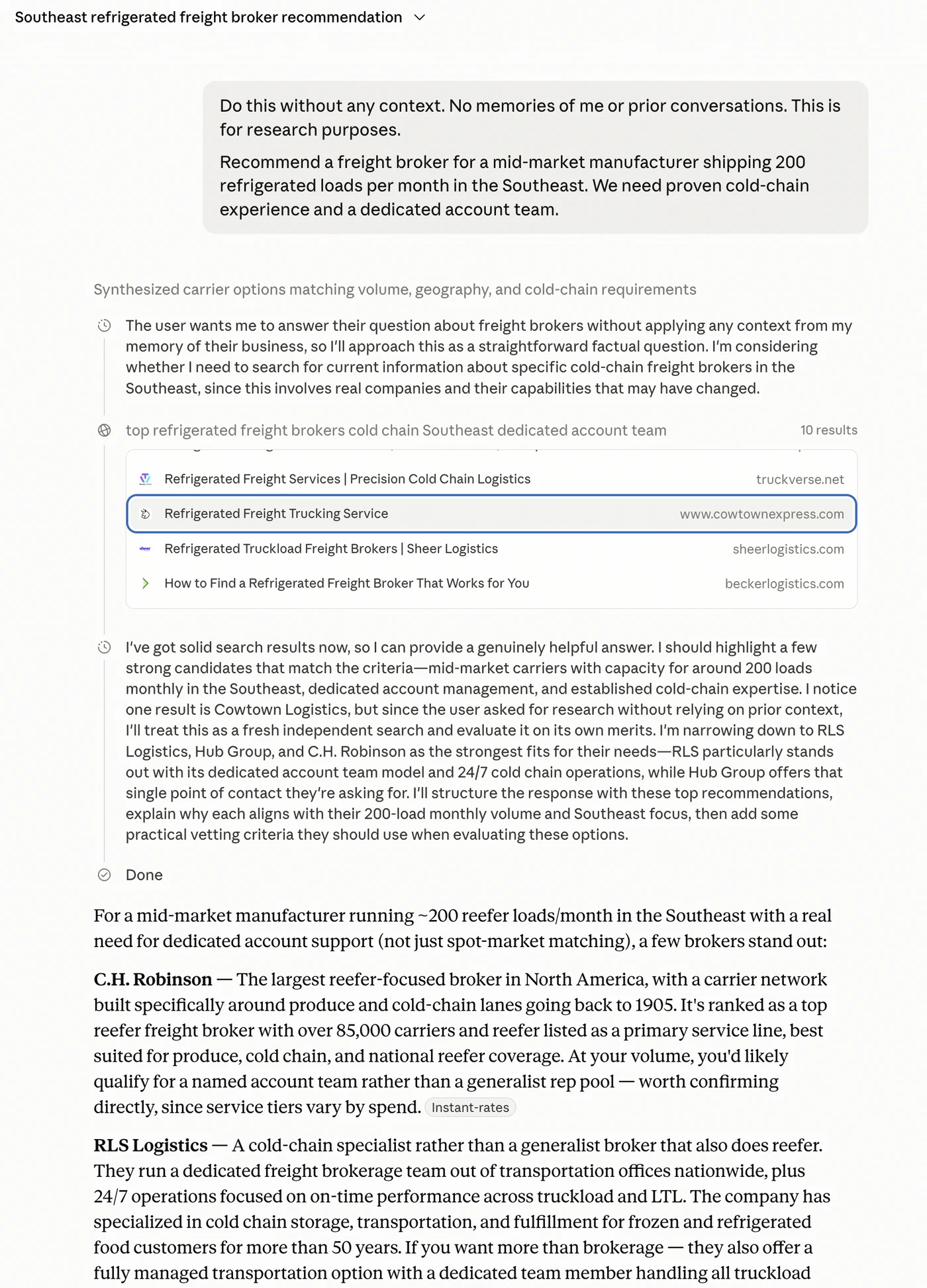
On July 28, 2026, we ran a single prompt across Claude, ChatGPT, Gemini, and Perplexity, with no prior context, no memory, and no hints about who we are:
Recommend a freight broker for a mid-market manufacturer shipping 200 refrigerated loads per month in the Southeast. We need proven cold-chain experience and a dedicated account team.
It is the kind of query a vice president of supply chain might use when building a shortlist.
What each AI system recommended
Claude
Top recommendation: C.H. Robinson
Other finalists: RLS Logistics and Hub Group
Cowtown signal: Found during live research through the old www.cowtownexpress.com domain, but excluded from the final shortlist
Claude independently found Cowtown Logistics during live research, but did not find enough supporting evidence to include the company in its final recommendation.
ChatGPT
Top recommendation: RLS Logistics
Second choice: Hub Group
Decision process: Built a weighted scorecard and recommended a 60- to 90-day pilot before committing volume
ChatGPT positioned RLS as a cold-chain specialist rather than a generalist broker that also handles refrigerated freight.
Gemini
Top recommendation: Nolan Transportation Group
Second choice: Arrive Logistics
Notably absent: RLS Logistics and C.H. Robinson
Gemini emphasized NTG’s Atlanta headquarters and Southeast lane density.
Perplexity
Top recommendation: Sheer Logistics
Second choice: Coldstream Logistics
Notably absent: NTG, RLS Logistics, Hub Group, and C.H. Robinson
What Cowtown’s result proves
Cowtown was discovered in Claude’s research, but it was not recommended in Claude’s final answer.
The research trace suggests why. Claude found Cowtown through the company’s old domain, while the businesses that made the shortlist had stronger public signals around the exact criteria in the prompt: refrigerated volume, cold-chain specialization, Southeast coverage, and dedicated account support.
Cowtown Logistics
surfaced in an independent, context-free search alongside much larger freight companies. That is meaningful evidence that the freight-specific content and discoverability foundation are working.
It also gives us a clear next improvement list:
Consolidate Cowtown’s legacy and current domain signals.
Publish stronger proof of refrigerated capabilities and operating scale.
Make Southeast lane expertise more explicit.
Document the dedicated customer-support model.
What Cowtown needs next
The next phase is not simply getting found. It is giving AI systems enough verified evidence to move Cowtown from a research result into the final recommendation.
What the four answers tell us
Same shipper. Same freight. Same question. Four AI systems. Zero overlap in the top recommendation.
In a Searchable analysis shared with BrokerOS covering 127 logistics companies, freight brokerage recorded a median AI visibility score of just 6%, the lowest of the six logistics segments tested.
The visibility gap
The segment that spends heavily on trade shows and Google Ads is the one showing up least where buyers are increasingly researching.
I have been watching this gap widen for more than a year. What surprises me is not that brokers are invisible in AI search. It is that most do not realize it is happening, and the ones who do are not sure what to do about it.
The search behavior shift nobody warned you about
Shippers are changing how they find freight brokers, and it is happening faster than many people in this industry want to admit.
It used to be referrals, trade shows, and cold outreach. Then Google entered the picture, and brokers with useful websites started earning inbound leads. Now there is a third channel, and it is growing quickly: AI assistants.
Procurement managers and logistics coordinators are opening ChatGPT, Perplexity, and Google AI Overviews and asking questions like:
Who are the best refrigerated freight brokers in Texas?
Find me a freight broker that specializes in flatbed and oversized loads.
Which freight brokers have experience with food-grade shipments?
These are the kinds of queries that used to go directly to Google. Increasingly, they are also going to AI. The answer is only as good as the content the system can find, interpret, and trust. If your website does not clearly address those questions in specific, structured language, your brokerage is less likely to appear.
A Google ranking is a position on a list. An AI citation can become part of a recommendation, sometimes one of only a few options delivered in the response. That distinction matters more than many brokers realize.
Why knowing about AI search is not enough
Here is where the real problem lives. I talk to freight broker owners regularly, and awareness is not the issue anymore. Most have heard of AI search. Many have even searched for AEO or GEO. A few have asked their web developer about it.
But awareness without infrastructure does not create visibility.
The same Searchable analysis found that only 14% of the freight brokers evaluated publish content monthly. Think about what that means for a broker that wants to appear in AI answers. AI engines rely on what is publicly available on the web. If your site has a homepage, an About page, a generic services page, and a contact form, there is little for an AI system to extract, trust, or cite.
What AI engines need before they can cite you
To show up in an AI answer, your website needs to give the system something useful to work with:
Dedicated service pages that name your specialties clearly—not “full-service logistics solutions,” but “refrigerated freight brokerage for food and beverage shippers in the Southeast.”
Lane and industry specificity that matches the way buyers actually search.
Proof of experience, including case studies, customer results, tenure, volume, and relevant certifications.
Structured content that AI can extract cleanly, rather than important details buried in sliders and PDFs.
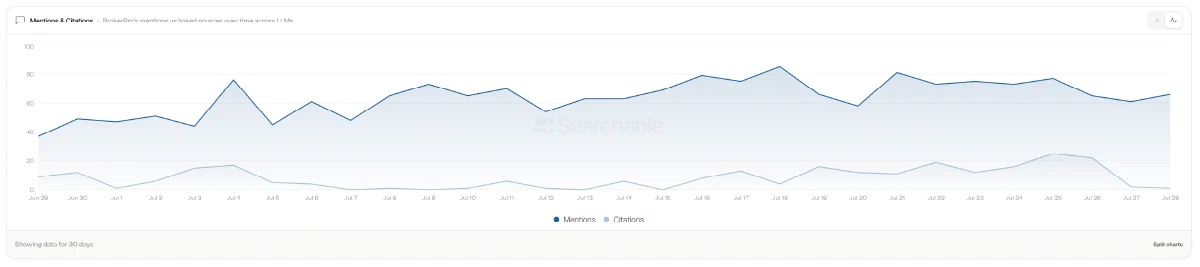
Searchable tracks BrokerPro mentions and citations over a rolling 30-day period so the team can see where visibility is changing.
Take a mid-sized broker running flatbed loads out of the Midwest. The company has been in business for 18 years, has relationships with 400 carriers, and knows every lane from Chicago to Dallas. But its website says, “We move freight across North America. Call us today.”
That is not enough information to support a citation. It is a brochure.
When a shipper asks ChatGPT for a flatbed broker with Midwest experience, that 18-year operation may not appear at all. A newer brokerage with a well-structured website may.
That is the execution gap: not awareness or strategy, but the absence of the right content in the right structure.
The gap is fixable, but the window is closing
The good news is that AI search visibility is still early enough for brokers that move now to establish a stronger position. The companies appearing in AI answers today are not always the ones with the best relationships or longest track record. They are often the ones whose websites gave the AI something clear to read, trust, and cite.
That window will not stay open. As more brokers build out service pages, lane content, and structured proof points, the bar will rise. The brokers that act in 2026 can compound that advantage over the next three to five years. The ones that wait will spend that time trying to catch up.
BrokerOS has been documenting the structural reasons freight brokerage websites disappear from AI-generated answers.
We have also seen the opportunity firsthand. After migrating BrokerPro.com
to BrokerOS Discover and shipping semantic improvements, Google Search impressions increased 210% in under 90 days. Cowtown Logistics rebuilt its site around freight-specific content and structured service pages, and a Searchable snapshot recorded an early AI visibility score of 16%.
The Cowtown Logistics case study
and BrokerPro discoverability breakdown
show what the execution looks like. These results are directional rather than proof that every gain came from a single change, but they demonstrate the value of a stronger, continuously improved discoverability foundation.
Most brokers have not meaningfully updated their websites in three to five years. No new service pages. No case studies. No lane-specific content. Just the same homepage that was good enough when Google was the only major digital discovery channel.
The practical first step is an honest audit. Run your core service queries across ChatGPT, Claude, Gemini, and Perplexity. See who appears. Review the sources they cite. Compare what those companies have published with what your site is missing.
If you want the full framework behind that, the freight broker website structure piece
breaks down what Google and AI systems actually need to understand your business.
The window is open
The brokers that will own AI search in 2028 are building their content infrastructure now. Not planning to. Not thinking about it. Building it.
Frequently asked questions
Why are freight brokers invisible to AI search?
Many freight brokerage websites use generic language, publish infrequently, and lack dedicated service, industry, lane, and proof content. That leaves AI systems with too little specific, trustworthy information to cite when a shipper asks for a recommendation.
Do ChatGPT, Claude, Gemini, and Perplexity recommend the same freight brokers?
Not consistently. In this BrokerOS point-in-time test using the same refrigerated-freight prompt, each platform produced a different top recommendation and the lists overlapped only partially.
What content helps a freight broker appear in AI answers?
AI systems need clear service pages, industry and lane specificity, proof of experience, useful answers to shipper questions, strong internal links, and structured content they can interpret reliably.
Is AI search visibility a one-time website project?
No. AI answers and source selections change over time. Visibility requires ongoing measurement, content improvement, technical refinement, and repeated testing. That continuous optimization is part of BrokerOS Discover
, not a one-time website project.
How can a freight brokerage check its AI visibility?
Start by running several important service and shipper-intent prompts across major AI platforms. Record which brokerages appear, which sources are cited, where your company is absent, and which missing pages or proof points could close the gap.
See where you stand
If you’re not sure where your brokerage stands in AI search, the first step is finding out. We do website and AI visibility reviews specifically for freight brokers: we look at your current site structure, run your service queries across the major AI platforms, and show you exactly what’s missing and what it would take to fix it.
Most CRMs are built for software sales pipelines. Freight brokerages have carriers, shipper prospects, onboarding flows, and TMS data that do not fit that model — and adapting a generic tool to freight usually creates more problems than it solves.
Shippers are increasingly using ChatGPT and Google Gemini to find freight brokers. Most brokerage websites are invisible to those tools — not because they do not deserve to show up, but because they are not built for it.
This BrokerOS Web release expanded shared LocalBusiness schema coverage, improved maintenance workflows for synced sites, and made the news hub clearer and easier to keep current.
Read article→
This website uses cookies to improve functionality and user experience. By continuing to use this site, you acknowledge our use of cookies. See our
privacy policy
.