Cowtown Logistics partnered with BrokerOS to rebuild its website as a freight-specific discoverability platform: clearer service pathways, stronger technical foundations, ongoing search-driven refinement, and content structured for both modern buyers and AI-assisted search environments.
For freight brokerages, a website is no longer just a brochure. It is often the first trust signal a shipper, carrier, recruit, or partner sees. It shapes whether the business feels current, specialized, and worth contacting before a sales conversation ever begins.
The challenge: a freight brokerage website has to do more than exist
Many freight brokerages are operating with websites that technically function but do not do enough to support growth.
The pages may be dated, thin, generic, or difficult to differentiate. They may say the company is reliable and service-focused, but never explain who it serves, what services matter most, why the team is credible, or what a prospect should do next.
Generic web agencies often miss the freight-specific context behind those decisions. A freight brokerage website needs more than surface-level design. It needs structure, clarity, proof, and conversion paths that reflect how the business actually operates.
For Cowtown Logistics, the opportunity was not to chase a cosmetic redesign. It was to build a site that could better support credibility, service discovery, conversion, and long-term content growth.
The opportunity: build a stronger public layer for Cowtown
The project was framed around strengthening Cowtown Logistics’s public layer, not just replacing pages.
The project focused on improving service clarity, strengthening shipper
and carrier
pathways, building a scalable content structure, and creating a stronger technical foundation for long-term discoverability and ongoing refinement.
That is the BrokerOS view of a website project. The site is not a standalone deliverable. It is part of the brokerage’s digital foundation, and it should be built as a search-ready content system that can easily support ongoing growth.
The BrokerOS approach
Freight-specific discovery
BrokerOS starts by understanding the brokerage itself.
That includes who the company serves, which services matter most, what types of freight it handles, how shippers evaluate it, what makes it different, and what a good inquiry actually looks like. Those answers shape the site more than generic mood boards or trend-driven layouts ever could.
For Cowtown Logistics, the goal was to make the website feel aligned with the business behind it. The messaging needed to reflect a real freight operation, not a generic small-business template.
Service architecture built for search and clarity
A modern freight broker website should make it easy for visitors to find the right path quickly.
That means clear navigation, logical service groupings, and pages that answer real buyer questions. Shippers should be able to understand relevant offerings without hunting through vague marketing copy. Carriers should be able to locate the right information and next steps. Search engines need a clearer topical structure, and AI systems also benefit when information is organized in a direct, readable way.
For Cowtown Logistics, that translated into a site structure that supports service discovery, carrier information, and quote or contact pathways more clearly than a flat brochure site can.
Content that explains the business, not just decorates the page
For BrokerOS, content structure and messaging are operational assets, not cosmetic additions.
Many freight broker websites still lean on generic language such as reliable service, customer-first solutions, or customized logistics support. That kind of wording rarely helps a buyer understand what the brokerage actually does.
BrokerOS approaches content differently. The copy should make the business easier to understand, easier to evaluate, and easier to contact - by humans and robots. It should describe the operation clearly enough that a shipper, carrier, or agent
can quickly understand what the company does and why it may be a fit.
That is especially important in freight, where credibility often depends on specificity.
Technical foundation
A stronger public layer also requires a stronger technical base.
For BrokerOS Web, that means fast, mobile-friendly pages, clean HTML, structured metadata where appropriate, stable URLs, crawlable content, clear internal linking, and launch-ready deployment practices. The goal is not technical complexity for its own sake. The goal is a site that is easier to trust, easier to maintain, and easier for search systems to process.
Those fundamentals support both user experience and discoverability.
Built to keep improving
Launch is not the finish line.
BrokerOS is designed as a managed growth platform for freight brokerages, which means the website will keep evolving after launch through content additions, page improvements, search-driven refinements, and ongoing maintenance. BrokerOS continuously monitors customer websites using technical SEO, discoverability, and AI-search visibility tools to guide ongoing improvements in content structure, entity clarity, technical performance, and search readiness.
Example: refining content based on discoverability signals
One example involved Cowtown Logistics’s legacy heavy-haul axle-weight guide:
Legal Axle Weight Limits for Trucks: Heavy Haul Weight Limits by State
.
The page was already showing meaningful search visibility and impression potential, but it had room to perform better for engagement and modern search interpretation. BrokerOS identified the opportunity through ongoing monitoring and refined the article with expanded FAQ content, FAQ structured data, clearer page hierarchy, stronger technical SEO support, and better alignment with how freight buyers and search systems evaluate content.
That is the BrokerOS model in practice: the website is not treated as a static launch project. High-potential pages are continuously evaluated and improved so the site can become easier for shippers, search engines, and AI-assisted discovery systems to understand over time.
That matters because websites go stale quickly when nobody owns the next iteration. Cowtown Logistics needed a stronger foundation, but also a model that would support improvement over time instead of leaving the site frozen the day it launched.
Why AI search mattered
Cowtown Logistics found BrokerOS after asking ChatGPT and Claude for recommendations, as the company explains in its own write-up about choosing BrokerOS
. That is a strong proof point for how buyer behavior is changing.
If decision-makers are using AI tools to discover vendors, then freight brokerages need websites that are easier for those systems to interpret. AI-assisted discovery does not replace Google. It raises the standard for clarity.
AI search did not change the fundamentals. It raised the bar.
Brokerages still need clear messaging, credible proof, useful content, and technically sound websites. What has changed is that this information now needs to be understandable not only to human visitors, but also to the systems summarizing and recommending businesses.
That is why BrokerOS emphasizes structured content, entity clarity, service-specific pages, internal linking, and a clean technical foundation. These are not gimmicks for AI. They are the same fundamentals that make a freight brokerage easier to understand in modern search.
The outcome: a website Cowtown Logistics can build on
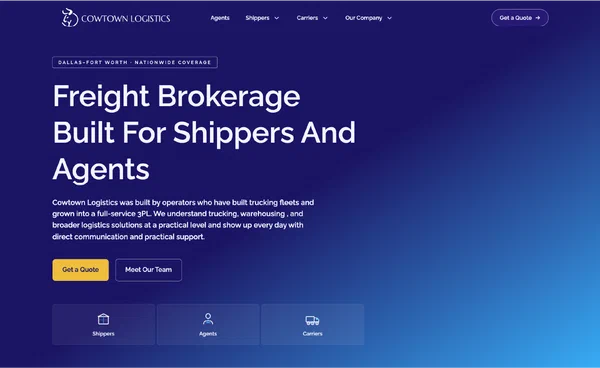
The finished site gives Cowtown Logistics a clearer story and a stronger first impression.
It presents the company in a way that is more aligned with how the business operates today. It provides a more credible public presence, clearer service discovery, and a better platform for future content and search improvements.
From the public site structure, the practical gains are visible in the way Cowtown Logistics can now support different audiences with clearer pathways for shipper services, carrier information, and quote or contact actions. That kind of organization helps visitors move faster and gives the business a more durable foundation for future growth.
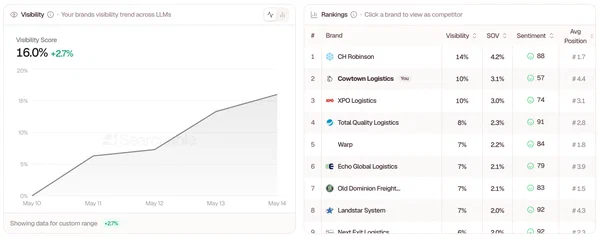
Early visibility data from AI-search monitoring platforms already shows Cowtown Logistics beginning to surface alongside significantly larger freight and logistics brands in modern discovery environments. The Searchable snapshot shown below records a 16.0% visibility score, up 2.7 points over the selected time range, while BrokerOS continues refining the site’s content structure, technical implementation, and discoverability signals to strengthen that positioning over time.
Cowtown Logistics AEO Visibility from Searchable.com
The outcome is not just a cleaner design. It is a better-positioned website for trust, discoverability, and ongoing improvement.
Customer validation
Cowtown Logistics’s public write-up provides useful third-party validation for what stood out in the process.
In their telling, BrokerOS differentiated itself through clear pricing, real collaboration, responsiveness, freight understanding, and a forward-looking approach to search. That is consistent with how BrokerOS Web is meant to operate: not as generic website design, but as a freight-specific growth layer built for credibility, discoverability, and long-term improvement.
Your website is part of your sales process, whether you treat it that way or not.
Why does freight-specific structure matter?
Freight-specific structure matters because buyers need to understand services, credibility, and next steps quickly.
What does AI search reward?
AI search rewards clarity, not slogans. The stronger the structure and messaging, the easier it is for search engines and AI systems to interpret the business.
Is website launch the finish line?
A website launch is not the finish line. The real value comes from having a platform that can keep improving.
What should the right website partner understand?
The right partner should understand both freight brokerage operations and the search environment shaping buyer behavior.
Build a freight brokerage website that is ready for modern search
BrokerOS helps freight brokerages build websites structured for discoverability, credibility, and long-term growth across modern search environments.
Cowtown Logistics is a Fort Worth-based freight brokerage serving shippers across Texas and beyond. The company specializes in full truckload freight, flexible capacity solutions, and long-term customer partnerships.
Author note
Josh Asbury
is Chief Operating Officer at Infinity Software Solutions
, the team behind BrokerOS. He works at the intersection of freight operations, digital growth, and structured website strategy for freight brokerages.
BrokerOS completed the Searchable AI Search Accelerator and is now a Certified Agency Partner, strengthening the AI search expertise available to freight brokerages through BrokerOS Discover.
A single freight broker recommendation prompt produced four different answers across Claude, ChatGPT, Gemini, and Perplexity. The results reveal a visibility problem most freight brokerages have not addressed.
Most CRMs are built for software sales pipelines. Freight brokerages have carriers, shipper prospects, onboarding flows, and TMS data that do not fit that model — and adapting a generic tool to freight usually creates more problems than it solves.
Read article→
This website uses cookies to improve functionality and user experience. By continuing to use this site, you acknowledge our use of cookies. See our
privacy policy
.